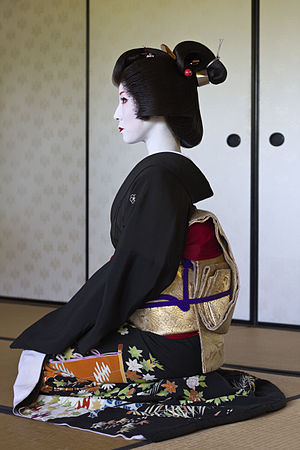
 Profile of Kimiha, a geisha from Miyagawa-chō, a hanamachi or geisha district in Kyoto. She is wearing a formal black kimono and a Shimada-styled nihongami wig. Her obi is tied in the "taiko" style. These details distinguish her from an apprentice, or maiko. Geisha are traditional Japanese female entertainers who act as hostesses and perform classical music, dance, games and conversation, mainly to entertain male customers.
3 Jul 2016
Geisha
Profile of Kimiha, a geisha from Miyagawa-chō, a hanamachi or geisha district in Kyoto. She is wearing a formal black kimono and a Shimada-styled nihongami wig. Her obi is tied in the "taiko" style. These details distinguish her from an apprentice, or maiko. Geisha are traditional Japanese female entertainers who act as hostesses and perform classical music, dance, games and conversation, mainly to entertain male customers.
2 Jul 2016
Pont Du Gard
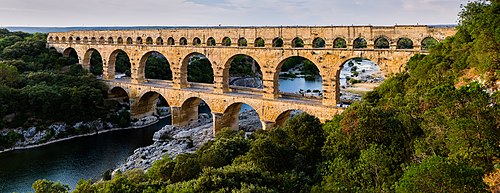
The Pont du Gard is an ancient Roman aqueduct bridge that crosses the Gardon River in southern France. Located near the town of Vers-Pont-du-Gard, the bridge is part of the Nîmes aqueduct built in the first century AD to carry water from a spring at Uzès to the Roman colony of Nemausus (Nîmes). Because of the uneven terrain between the two points, the mostly underground aqueduct followed a long, winding route that called for a bridge across the gorge of the Gardon River. The Pont du Gard is the highest of all elevated Roman aqueducts, and, along with the Aqueduct of Segovia, one of the best preserved.
1 Jul 2016
Battle of the Somme
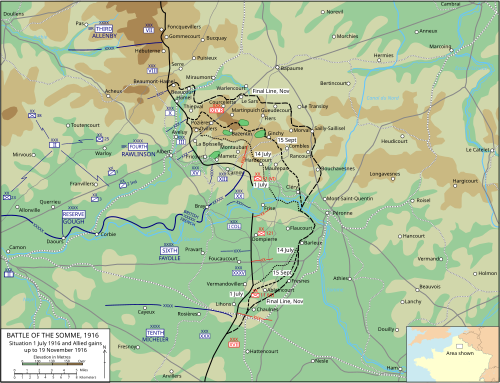
The Battle of the Somme was a battle of the First World War fought between 1 July and 18 November 1916 by the armies of the British and French empires against theGerman Empire. The largest battle of World War I on the Western Front, it was fought on both sides of upper reaches of the River Somme in France. More than one million men were wounded or killed, making it one of the bloodiest battles in human history.
29 Jun 2016
Hip, Hip, Hurrah!

Hip, Hip, Hurrah! is an oil painting on canvas by the Norwegian-Danish painter Peder Severin Krøyer. Completed between 1884 and 1888 in the style of the French Impressionists and Naturalists, it shows theSkagen Painters during a party at Michael Ancher's house. It is presently in the Gothenburg Museum of Art, having been donated by the art collector Pontus Fürstenberg.
28 Jun 2016
The Fringes of the Fleet
_-_cleaned.jpg/300px-Rudyard_Kipling_-_The_Fringes_of_the_Fleet_(cover)_-_cleaned.jpg) The Fringes of the Fleet is a booklet written in 1915 by Rudyard Kipling. It contains essays and poems about nautical subjects in World War I. Lyrics from poems in this booklet were used for a song-cycle of the same name written in 1917, with music by the English composer Edward Elgar and lyrics. This song cycle was first recorded by Elgar on 4 July 1917, with singers Charles Mott, Frederick Henry, Frederick Stewart and Harry Barratt.
The Fringes of the Fleet is a booklet written in 1915 by Rudyard Kipling. It contains essays and poems about nautical subjects in World War I. Lyrics from poems in this booklet were used for a song-cycle of the same name written in 1917, with music by the English composer Edward Elgar and lyrics. This song cycle was first recorded by Elgar on 4 July 1917, with singers Charles Mott, Frederick Henry, Frederick Stewart and Harry Barratt.
27 Jun 2016
Fernanda Lima
 Fernanda Lima (b. 1977) is a Brazilian actress, model, businesswoman, journalist, and television host. Following a short career in film and telenovelas, she established herself in popular culture as the host of a variety of shows on MTV Brasil, Rede TV!, and Globo TV. In 2014, she was contracted by FIFA to be the muse of the World Cupand of the Ballon d'Or.
26 Jun 2016
Mary Ellen Best

An Interior, a drawing by Mary Ellen Best (c. 1838). Best (1809–1891) was a British artist, active mostly in the 1830s, who worked predominantly with watercolours. Unlike many of her contemporaries, she was interested in portraying domestic life in her works, including families at tables, kitchens, and domestic workers. Among her estimated 1,500 paintings are a number of interior portraits such as this; she is known to have painted, among other subjects, images of the drawing room, dining room, and common room of her home in Castle Gate, York.
24 Jun 2016
Blenduk Church
 Blenduk Church, formally the Immanuel Protestant Church of Western Indonesia, is a Protestant church inSemarang, Central Java, Indonesia. Established in 1753, it is the oldest church in the province. The current building dates back to 1787; the towers and dome were added in 1894.
23 Jun 2016
Streaked Spiderhunter
 A streaked spiderhunter (Arachnothera magna) on a banana inflorescence in Kaeng Krachan National Park, Phetchaburi, Thailand. This species, which is similar in size to a sparrow, can be found in subtropical or tropical moist forests (both lowland and montane) in much of South and Southeast Asia. The streaked spiderhunter feeds on the nectar of flowers such as the wild banana blossom.
21 Jun 2016
Draco
 Draco is a constellation in the far northern sky. Its name is Latin for dragon. It was one of the 48 constellations listed by the 2nd century astronomer Ptolemy and remains one of the 88 modern constellations today. Draco is circumpolar and can thus be seen all year from northern latitudes.
This illustration comes from Urania's Mirror, a set of 32 astronomical star chart cards first published in November 1824. Shown beneath Draco is Ursa Minor.
Subscribe to:
Posts (Atom)