23 Dec 2016

Gravel Pit

A panoramic view of the gravel pit near Kongensbro, Denmark, which is operated by BG Stone. Gravel pits are open-pit mines for extraction of gravel and often lie in river valleys where the water table is high. As such, pits may naturally fill with water, and abandoned ones are often used as nature reserves or as amenity areas for water sports, landfills and walking.

Nuremberg

Nuremberg is a census-designated place in Schuylkill and Luzerne counties, Pennsylvania, United States. The population was 434 at the 2010 census. It occupies a total area of 0.58 square miles (1.5 km2).

13 Dec 2016

European Robin

The European robin (Erithacus rubecula) is a small insectivorous passerine bird in the Old World flycatcher family. Around 12.5–14.0 cm (5.0–5.5 in) in length, the male and female are similar in colouration, with an orange breast and face lined with grey, brown upperparts and a whitish belly. It is found across Europe, east to Western Siberia and south to North Africa; it is sedentary in most of its range except the far north.

11 Dec 2016

Mass Grave

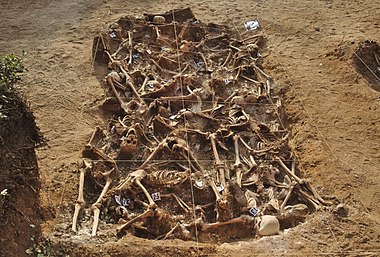
A mass grave of 26 Republican victims killed by Nationalists in 1936 during the Spanish Civil War. This grave was excavated in Estépar, Burgos, in 2014.
Generally speaking, mass graves contain multiple bodies that may or may not be identified prior to burial. They may be seen after violent conflict or be dug for sanitation reasons after a major famine, epidemic, or natural disaster.

17 Nov 2016

Cymon and Iphigenia

Cymon and Iphigenia is an oil on canvas painting by Frederic Leighton, that was first exhibited at the Royal Academy of Arts, London, in 1884. Based on the story of Iphigenia and her transformation of the lout Cymon into a veritable polymath, the painting has been described as emphasizing "the transforming power of beauty." The Art Gallery of New South Wales in Sydney, Australia, purchased this painting at a Christie's auction in 1976.

7 Nov 2016

Canadian Coast Guard

A rescue exercise being undertaken by the Royal Canadian Air Force and the Canadian Coast Guard. Formed in 1962, the Canadian Coast Guard is a Special Operating Agencywithin Fisheries and Oceans Canada. It is headquartered in Ottawa, Ontario. Unlike some other coast guardorganizations, it does not have naval or law enforcement responsibilities.

5 Sept 2016

Plum Park in Kameido

Plum Park in Kameido is a woodblock print in the ukiyo-e genre by the Japanese artist Hiroshige. It was published in 1857 as the thirtieth print in the One Hundred Famous Views of Edo series and depicts Prunus mume trees in bloom. Popular prints such as Plum Park in Kameido were produced in the tens of thousands at a low individual cost. After the opening up of Japan in 1853, they found a following in Europe, where they had a significant influence on the Impressionist artists, and onPost-Impressionists such as Vincent van Gogh.

3 Sept 2016

The Great Day of His Wrath

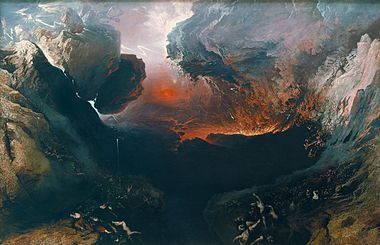
The Great Day of His Wrath is an 1851–1853 oil painting on canvas by the English painter John Martin. It has variously been described as showing the "destruction of Babylon and the material world by natural cataclysm" (as a response to the emerging industrial scene of London), "the collapse of Edinburgh in Scotland", and a portion of the Biblical Book of Revelation. The painting is held by Tate Britain in London.

20 Aug 2016

Morpho Didius

A ventral view of Morpho didius, a Neotropical butterfly belonging to the subfamily Morphinae of familyNymphalidae. With a wingspan reaching 150 mm (5.9 in), it is one of the largest of Morpho species.

12 Aug 2016

Hughes Medal

The Hughes Medal is awarded by the Royal Society of London "in recognition of an original discovery in the physical sciences, particularly electricity and magnetism or their applications". Named after David E. Hughes, the medal is awarded with a gift of £1000. The medal was first awarded in 1902 to J. J. Thomson (pictured) "for his numerous contributions to electric science, especially in reference to the phenomena of electric discharge in gases", and has since been awarded over one hundred times. Unlike other Royal Society medals, the Hughes Medal has never been awarded to the same individual more than once. The medal has on occasion been awarded to multiple people at a time; in 1938 it was won by John Cockcroft and Ernest Walton, in 1981 byPeter Higgs and Tom Kibble, in 1982 by Drummond Matthews and Frederick Vine and in 1988 by Archibald Howie and M.J. Whelan.